
Volume 11: Issue 3, July–December, 2019

Table of Contents
Abstract: Management override of internal controls has long been viewed as a critical impediment to fraud prevention efforts; however, research on management override has been severely limited by a lack of data. This exploratory study uses Association of Certified Fraud Examiners (ACFE) occupational fraud data from 2002 to 2015 to examine fraud cases involving management override versus fraud cases involving a lack of internal controls. The results reveal several unique dimensions of management override fraud relative to cases involving a lack of internal controls. Perhaps most striking is that management override fraud is relatively more common when the organization’s anti-fraud environment is stronger (specifically, an internal audit function, independent audits of the financial statements, an anti-fraud policy, or a code of conduct are in place). Thus, strong anti-fraud efforts in organizations appear to push some motivated fraudsters to override otherwise effective internal controls. We provide the first large sample, empirical insights into the unique nature of management override fraud cases, and we discuss implications for fraud prevention and future research directions.
Abstract: Public and private companies seeking to comply with the Financial Accounting Standards Board’s Accounting Standards Codification 805 (ASC 805) may encounter subsequent audit issues when applying a control premium during the Purchase Price Allocation process. Control premiums can exacerbate or be the cause for an impairment charge under Financial Accounting Standard Board’s Codification 350 (ASC 350). Hence, the purchase price allocation process (ASC 805) should be viewed by shareholders with caution. More importantly, the subsequent impairment charge may lead to shareholder lawsuits when a company’s earnings plummet leading to the possibility of a bankruptcy filing in subsequent years.
Abstract: Contextual understanding of situations, circumstances, and processes go beyond mere individual observations, intuitive perception, and individualistic explanations. Cultural understanding of environment and condition, including how contextual information is perceived and conveyed, is also an important consideration in understanding the lenses in which we view, communicate within, and interact with the world. Moreover, the influence of power, values, and imposed standards in mediating these relationships may prove equally important. Current explanations of fraud oftentimes provide individual rationales for engagement in fraudulent criminal behavior. This research proposes both a macro-level (group) and micro-level (individual) analysis of fraud utilizing an instrument to determine an organization’s overall fraud risk score. Moreover, through this research, a new concept for fraud analysis is proposed coined Discourse Fraud Analysis (DFA). Additionally, this research examines the relevance of a proposed fraud analysis tool to assist accounting and auditing professionals. This article also serves as a primer for discussion regarding limitations of historical fraud models in explaining these relationships and how Discourse Fraud Analysis may be used to detect fraud. This study utilizes critical discourse analysis and a qualitative research design by providing a DFA scoring matrix that can be used by practitioners.
Abstract: Due to the FDIC not being allowed to have confidential settlements, PricewaterhouseCoopers (PwC) was forced to go to trial for professional accounting malpractice. Thus, the December 2017 liability phase and the March 2018 damages phase of the bench trial provide a glimpse at how badly accounting firms may be auditing, and why they miss major frauds. This article provides the background of the Colonial Bank fraud, details of how the fraud was perpetuated, and the ways in which Colonial executives and employees colluded. A brief summary is given regarding the District Court’s guilty decision and the unprecedented award to the FDIC of $625.3 in damages. Next, factors that may have contributed to the fraud are presented including suggested violations of auditing standards and potential violations of ethical standards. Finally, a perfect storm of events threatens to bankrupt or severely impact some of the major accounting firms.
Keywords: Colonial Bank; PricewaterhouseCoopers; PwC; fraud; FDIC; TBW; accounting ethics; malpractice
Abstract: This article explores the current fraud issues for donation-based crowdfunding and offers suggestions to help mitigate the most pervasive issues presented. The focus of this study is directed at the current largest donation-based crowdfunding website, GoFundMe. GoFundMe claims to have received over five billion dollars in donations since inception. GoFundMe is the first donation-based crowdfunding site to offer any form of fraud protection for consumers, but it is not clear if their policies are effective. The legal environment surrounding donation-based crowdfunding is virtually non-existent, leaving many open doors for consumer frauds and tax frauds to occur. Consumers are unaware of many of these issues at large. This article considers all these facts and attempts to provide awareness regarding the issues to institute both effective change and increased consumer protections.
Abstract: Engagement triggers are tools that capture students’ attention and direct it to a new topic or to the day’s lecture. By focusing on cartoons and short online videos, two examples of engagement triggers, the authors demonstrate how to use innovative and engaging online resources to enliven the forensic accounting and fraud auditing classroom. To achieve this objective, the authors present resources that are useful in the teaching of forensic accounting and fraud auditing. While cartoons often utilize humor and wit to convey a message or provide social critique, online videos illustrate fraud cases and their investigation, thereby demonstrating class concepts in practice.
Abstract: Off-balance-sheet financing has been a continuing source of tension between financial statement preparers and users. The current categorization of leases has resulted in a massive amount of earnings management by corporate financing being left off the balance sheet, particularly in selected industries. The Financial Accounting Standards Board (FASB) and International Accounting Standards Board (IASB) conducted a joint project to improve the accounting treatment of leases, leading to the publishing of Accounting Standards Codification (ASC) 842 and International Financial Reporting Standards (IFRS) 16. These new rules went into effect on January 1, 2019.
Abstract: Firms continue to experience cybersecurity breaches that have a negative impact on their performance and reputation. When firms engage in various business strategies, the firm’s IT environment complexity increases leading to more risk exposure. Therefore, using complexity theory, we identify seven financial measures that reflect a firm’s business strategy (i.e., growth, acquisitions, restructuring, leverage, concentration of segment revenues, size, and profits), and develop a model to predict the likelihood of a cybersecurity breach. We find that firms with reported cybersecurity breaches have significantly higher growth rates, have higher concentration of segment revenues, are larger and are more profitable with marginally fewer acquisitions than their counterparts without reported breaches. Further, telecommunications and information technology sectors have relatively more breaches than other sectors. The developed model based on financial measures correctly predicts up to eighty-eight of firms as either having a reported cybersecurity breach or not. These findings directly and indirectly contribute to the Information Technology (IT) governance literature, profession and current discussions on voluntary disclosures on cybersecurity risks.
- Unique Characteristics of Management Override Fraud Cases
- VFR Valuation Advisory #3: A Groundwork for Fraudulent Financial Reporting
- Discourse Fraud Analysis: A New Paradigm for Forensic and Investigative Accounting
- PwC and the Colonial Bank Fraud: A Perfect Storm
- Crowdfunding: Are Those in Need Really Being Served?
- Using Engagement Triggers in Forensic Accounting Classes
- New Accounting Standards for Leases and their Possible Impacts on Financial Analysis
- Predicting Reported Cybersecurity Breaches Using Financial Measures
- Book Reviews
Unique Characteristics of Management Override Fraud Cases | Full Article (PDF)
Carol C. Bishop
Dana R. Hermanson
Jonathan T. Marks
Richard A. Riley, Jr.
Abstract: Management override of internal controls has long been viewed as a critical impediment to fraud prevention efforts; however, research on management override has been severely limited by a lack of data. This exploratory study uses Association of Certified Fraud Examiners (ACFE) occupational fraud data from 2002 to 2015 to examine fraud cases involving management override versus fraud cases involving a lack of internal controls. The results reveal several unique dimensions of management override fraud relative to cases involving a lack of internal controls. Perhaps most striking is that management override fraud is relatively more common when the organization’s anti-fraud environment is stronger (specifically, an internal audit function, independent audits of the financial statements, an anti-fraud policy, or a code of conduct are in place). Thus, strong anti-fraud efforts in organizations appear to push some motivated fraudsters to override otherwise effective internal controls. We provide the first large sample, empirical insights into the unique nature of management override fraud cases, and we discuss implications for fraud prevention and future research directions.
Keywords: Fraud; management override; internal control; ACFE Report to the Nations; code of conduct
VFR Valuation Advisory #3: A Groundwork for Fraudulent Financial Reporting | Full Article (PDF)
Matthew D. Crane
James A. DiGabriele
Peter L. Lohrey
Joseph R. Nicholson
Abstract: Public and private companies seeking to comply with the Financial Accounting Standards Board’s Accounting Standards Codification 805 (ASC 805) may encounter subsequent audit issues when applying a control premium during the Purchase Price Allocation process. Control premiums can exacerbate or be the cause for an impairment charge under Financial Accounting Standard Board’s Codification 350 (ASC 350). Hence, the purchase price allocation process (ASC 805) should be viewed by shareholders with caution. More importantly, the subsequent impairment charge may lead to shareholder lawsuits when a company’s earnings plummet leading to the possibility of a bankruptcy filing in subsequent years.
In an attempt to provide clarity, the Appraisal Foundation issued VFR Valuation Advisory #3: The Measurement and Application of Market Participant Acquisition Premiums (MPAP 3). This advisory suggests that best practices for valuation specialists requires the application a premium be applied to Total Invested Capital (TIC) rather than to Equity—when shareholders acquiring control. MPAP 3 suggests the use of a comparative income approach—based on a range of observable market-based TIC premiums. It also states that when control premiums are expressed as a percentage of equity, a company which is more than fifty percent equity financed will understate the premium percentage for control. The decision to apply a control premium to a majority stockholder’s ownership interest is a highly subjective process. Further, it is complicated by the fact that the measure selected may be highly inaccurate. The quantification of perceived benefits for a majority shareholders’ ownership interest makes sense when trying to improve the reliability of account balances used for financial reporting purposes. Yet, stock market price premiums are based upon stock price, not the allocation of a purchase price by a valuation specialist.
The application of a control premium when performing a purchase price allocation based on TIC rather than Equity creates a higher premium which leads to additional goodwill. An increase to goodwill will diminish the likelihood of future impairment charges under ASC 350. When impairment charges do occur, they will lead to declines in future reported earnings. These declines, in turn, can lead to a severe downturn in stock price. A decline in a company’s stock price makes the cost of equity capital more expensive. This, in turn, can lead to greater levels of debt financing for businesses with significant tangible assets—despite the belief that stockholders should be indifferent to a company’s capital structure. This reliance on increased levels of debt financing for future business growth—due to a decrease in stock price related to impairment charges resulting from the application of market participant acquisition premiums—leads to a greater chance of bankruptcy sometime in the future.
The MPAP has provided new guidance, but it has not provided any empirical evidence to demonstrate how strong the relationship must be between the control premium and the measures they suggest be used to estimate the premium. It also does not provide any guidance on the appropriate procedures to be used to determine the robustness of the relationship. Finally, the MPAP has not provided any guidance on how to test for reliability. Reliance on the current MPAP guidance may lead to future shareholder disputes and the potential for accounting fraud due to the misuse by management of the MPAP methodology. Our results indicate that the recommended use of TIC by the MPAP has validity, but most of the variables suggested for use in applying a control premium under ASC 805 are arbitrary at best. This paper provides forensic accountants and valuation specialists with insight into a key issue surrounding the application of a control premiums. It also serves to alert both valuation specialists and auditors to a critical weakness in the current guidance provided by the Appraisal Foundation’s VFR Valuation Advisory #3. We conclude by proposing improved alternatives for consideration as “a best practice” by valuation specialists and audit firms.
Keywords: Control premiums; mergers and acquisitions; intangible assets; goodwill; impairment testing; fair value measurements
Discourse Fraud Analysis: A New Paradigm for Forensic and Investigative Accounting | Full Article (PDF)
Brian K. Harte
Scott P. McHone
Abstract: Contextual understanding of situations, circumstances, and processes go beyond mere individual observations, intuitive perception, and individualistic explanations. Cultural understanding of environment and condition, including how contextual information is perceived and conveyed, is also an important consideration in understanding the lenses in which we view, communicate within, and interact with the world. Moreover, the influence of power, values, and imposed standards in mediating these relationships may prove equally important. Current explanations of fraud oftentimes provide individual rationales for engagement in fraudulent criminal behavior. This research proposes both a macro-level (group) and micro-level (individual) analysis of fraud utilizing an instrument to determine an organization’s overall fraud risk score. Moreover, through this research, a new concept for fraud analysis is proposed coined Discourse Fraud Analysis (DFA). Additionally, this research examines the relevance of a proposed fraud analysis tool to assist accounting and auditing professionals. This article also serves as a primer for discussion regarding limitations of historical fraud models in explaining these relationships and how Discourse Fraud Analysis may be used to detect fraud. This study utilizes critical discourse analysis and a qualitative research design by providing a DFA scoring matrix that can be used by practitioners.
Keywords: Forensic accounting; critical discourse analysis; forensic tool; fraud detection; fraud prevention; investigative auditing; scoring matrix
PwC and the Colonial Bank Fraud: A Perfect Storm | Full Article (PDF)
Donald L. Ariail
D. Larry Crumbley
Abstract: Due to the FDIC not being allowed to have confidential settlements, PricewaterhouseCoopers (PwC) was forced to go to trial for professional accounting malpractice. Thus, the December 2017 liability phase and the March 2018 damages phase of the bench trial provide a glimpse at how badly accounting firms may be auditing, and why they miss major frauds. This article provides the background of the Colonial Bank fraud, details of how the fraud was perpetuated, and the ways in which Colonial executives and employees colluded. A brief summary is given regarding the District Court’s guilty decision and the unprecedented award to the FDIC of $625.3 in damages. Next, factors that may have contributed to the fraud are presented including suggested violations of auditing standards and potential violations of ethical standards. Finally, a perfect storm of events threatens to bankrupt or severely impact some of the major accounting firms.
Keywords: Colonial Bank; PricewaterhouseCoopers; PwC; fraud; FDIC; TBW; accounting ethics; malpractice
Crowdfunding: Are Those in Need Really Being Served? | Full Article (PDF)
Richard G. Brody
Leandra Trujillo
Michael Shenberger
Abstract: This article explores the current fraud issues for donation-based crowdfunding and offers suggestions to help mitigate the most pervasive issues presented. The focus of this study is directed at the current largest donation-based crowdfunding website, GoFundMe. GoFundMe claims to have received over five billion dollars in donations since inception. GoFundMe is the first donation-based crowdfunding site to offer any form of fraud protection for consumers, but it is not clear if their policies are effective. The legal environment surrounding donation-based crowdfunding is virtually non-existent, leaving many open doors for consumer frauds and tax frauds to occur. Consumers are unaware of many of these issues at large. This article considers all these facts and attempts to provide awareness regarding the issues to institute both effective change and increased consumer protections.
Keywords: Crowdfunding; donations; fraud; prevention; GoFundMe education
Using Engagement Triggers in Forensic Accounting Classes | Full Article (PDF)
Norbert Tschakert
Zlatinka Blaber
Zlatinka Blaber
Lisa Chen
Abstract: Engagement triggers are tools that capture students’ attention and direct it to a new topic or to the day’s lecture. By focusing on cartoons and short online videos, two examples of engagement triggers, the authors demonstrate how to use innovative and engaging online resources to enliven the forensic accounting and fraud auditing classroom. To achieve this objective, the authors present resources that are useful in the teaching of forensic accounting and fraud auditing. While cartoons often utilize humor and wit to convey a message or provide social critique, online videos illustrate fraud cases and their investigation, thereby demonstrating class concepts in practice.
Keywords: Engagement triggers; forensic accounting; fraud investigation; cartoons; videos; student engagement; humor
New Accounting Standards for Leases and their Possible Impacts on Financial Analysis | Full Article (PDF)
Robert Forbes
Gaurav Gupta
Abstract: Off-balance-sheet financing has been a continuing source of tension between financial statement preparers and users. The current categorization of leases has resulted in a massive amount of earnings management by corporate financing being left off the balance sheet, particularly in selected industries. The Financial Accounting Standards Board (FASB) and International Accounting Standards Board (IASB) conducted a joint project to improve the accounting treatment of leases, leading to the publishing of Accounting Standards Codification (ASC) 842 and International Financial Reporting Standards (IFRS) 16. These new rules went into effect on January 1, 2019.
The purpose of this article is to review the history of this issue, provide a review of the new IFRS and GAAP rules regarding the accounting treatment of leases, and determine the impacts of the policy change on financial analysts and investors.
We start with the historical background and financial rationale for the changes, along with the process used in reaching the final policy and the timeline for implementation. Next, we look at the modifications to financial statement reporting and the corresponding impacts on various methods of stock valuation. The specific note is taken in the industries where the change will have the most impact. Finally, we conclude with an assessment as these policies take effect as well as possible profit potential for the companies most affected by the change.
Keywords: Leases; earnings management; off-balance-sheet; transparency; finance lease; operating lease
Predicting Reported Cybersecurity Breaches Using Financial Measures | Full Article (PDF)
Nishani Edirisinghe Vincent
John Trussel
Abstract: Firms continue to experience cybersecurity breaches that have a negative impact on their performance and reputation. When firms engage in various business strategies, the firm’s IT environment complexity increases leading to more risk exposure. Therefore, using complexity theory, we identify seven financial measures that reflect a firm’s business strategy (i.e., growth, acquisitions, restructuring, leverage, concentration of segment revenues, size, and profits), and develop a model to predict the likelihood of a cybersecurity breach. We find that firms with reported cybersecurity breaches have significantly higher growth rates, have higher concentration of segment revenues, are larger and are more profitable with marginally fewer acquisitions than their counterparts without reported breaches. Further, telecommunications and information technology sectors have relatively more breaches than other sectors. The developed model based on financial measures correctly predicts up to eighty-eight of firms as either having a reported cybersecurity breach or not. These findings directly and indirectly contribute to the Information Technology (IT) governance literature, profession and current discussions on voluntary disclosures on cybersecurity risks.
Keywords: Cybersecurity; IT complexity; financial measures; cybersecurity risk; disclosures analysis
| Book Reviews |

The Confidence Game
Maria Konnikova, 2016, 340 pp.
Penguin Random House
375 Hudson Street
New York, N.Y. 10014
In a real sense, an executive fraudster must be a con man. The author states that “the story of belief—of the basic, irresistible, universal human need to believe in something that gives life meaning, something that reaffirms our view of ourselves, the world, and our place in it.” They must prepare financial statements that are believable. Think of Bernie Madoff, Jim Bakkers, Ken Lay, Sanjay Kumar, Dennis Kozlowski, Eddie Antar, and the many other fraudsters. They used other’s trust in them for their own private purposes. Bernie Madoff went undetected for at least twenty years.
Konnikova examines Bernie Madoff, Australian Samantha Azzopardi, Oscar Hartzell, art dealer Glafira Rosales, Professor Paul Frampton, Investor Hub Matthew Brown, and others. This book reminds accountants and investors to be skeptical in all they do.
|

Data Analytics for External Auditors
International Accounting, Auditing and Ethics, 2016
iaae@icaew.com
Chartered Accountants’ Hall, 2016, 28 pp.
Moorgate Place London ECZR6EA U.K.
An informative pamphlet showing how data analytics can enhance audit quality. Data analytics enables authors to manipulate a complete data set—100% of the transactions in a population—and for non-specialists to visualize results graphically, easily, and at speed.
Data analytics is a new discipline for auditors. It requires a substantial investment in hardware, software, skills and quality control. It is an important part of the response of larger and mid-tier firms to market demands in the large-company audit market. Data analytics can be applied to a wide range of assurance engagements, not just audit.
Data analytics enables auditors to improve the risk assessment process, substantive procedures and tests of controls. It often involves very simple routines, but it also involves complex models that produce high-quality projections. Auditors using such models need to understand them, and to exercise significant judgement in determining when and how they should be used.
|
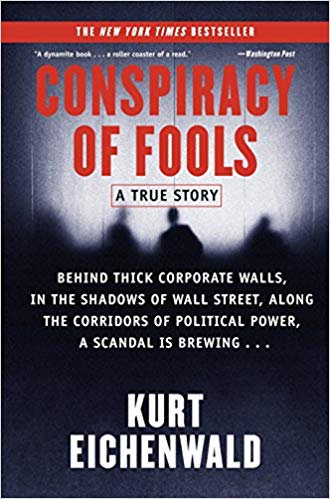
Conspiracy of Fools
Kurt Eichenwald, 2005, 742 pp.
Broadway Books
1714 NE Broadway
Portland, OR 97232
This book is the story of Ken Lay and the cast of characters that played games with Enron’s finances, ending in a seventy-eight-billion-dollar fraud. We tend to ignore history. As Howard Schilit said: “The one lesson we have learned from history is that we have learned nothing from history. In order to find fraud, we have to study the history of fraud.”
The Equity Funding has faded from our memory, but along came TBW/Colonial Bank with a sale of around $468 million fake and forged documents. An accounting intern was assigned the task of auditing these significant assets. She copied prior working papers and used them for the next year’s audit.
Then there are the recent Theranos, Inc., Steinhoff International, Danske Bank, and Mitchell Energy Resources frauds, to name a few. Time to re-gain skepticism by reviewing the story of lies, crimes, and ineptitude of the Enron scandal. Writing in the roller-coaster style of a novel, the investigative reporter takes readers behind closed doors from the Oval Office to executive suites. He lays out unbelievable scenes that twist together to create the shocking fraud.
Should this drama be on your bookcase for night-time reading when you begin to be believed executives? Remember the lowest form of evidence is management representations.
|
|
Events: Save the Date! NACVA and the CTI’s 2020 Business Valuation and Financial Litigation Super Conference The NACVA and the CTI’s 2020 Business Valuation and Financial Litigation Super Conference will be held June 18–20, 2020, in Phildelphia, PA, at the Loews Philadelphia Hotel. Early registration discounts are available. To learn more and register, visit http://www.BVFLSConference.com/, or call Member/Client Services at (800) 677-2009. |
.png)